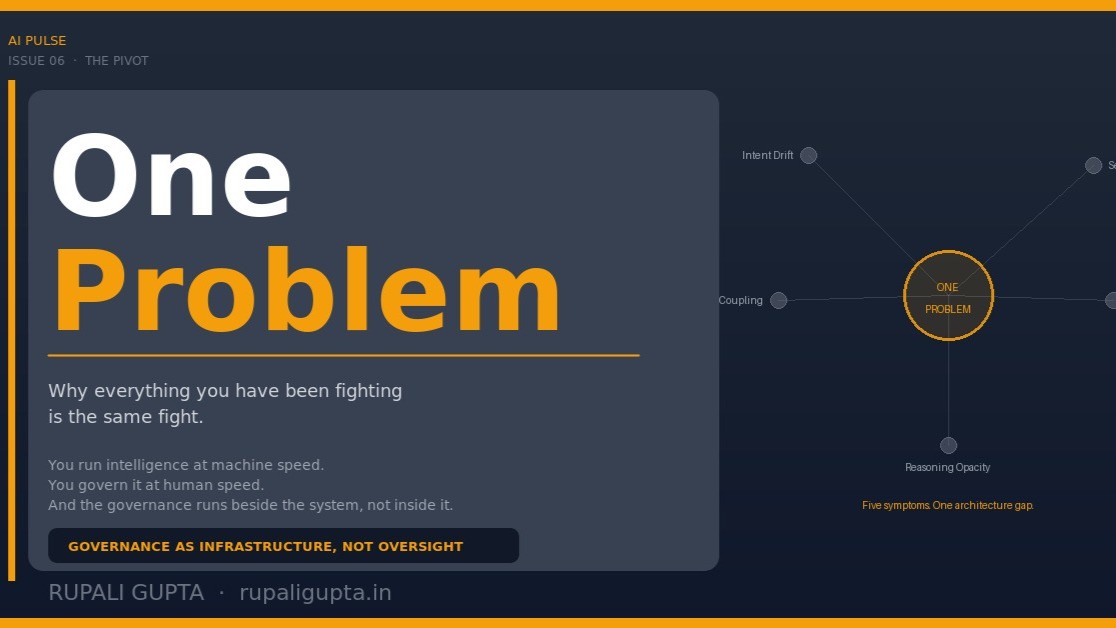
One Architecture Problem: Why Everything You Have Been Fighting Is the Same Fight
For five weeks I described five problems. I need to tell you something. They were never five problems
For the last several weeks, I have written to you about what looked like five separate problems.
Intent drift, where autonomous agents slowly stop doing what they were built to do. Semantic contracts, where the meaning of data changes without the schema changing. Integration coupling, where hidden dependencies corrupt the inputs agents rely on. Cost as a control signal, where an agent's economics reveal behavioral change before anything else does. And reasoning opacity, where the story an agent tells about its decisions is not the same as how it actually made them.
five issues. five problems. five different technical domains, each with its own failure mode, its own detection challenge, its own remediation. I need to tell you something now that I structured these issues deliberately to build toward.
They were never five problems.
They are five symptoms of one problem. And once you see the single condition underneath them, the entire way you approach governing enterprise AI changes.
The one problem Here is the condition that produces all five symptoms.
Your organization is running intelligence at machine speed and governing it at human speed. And the governance is not built into the system. It runs alongside the system, always one step behind, reviewing decisions after they have already been made. Every symptom I described traces back to this single structural gap.
Intent drift happens because the agent's intent is not continuously governed. It is defined once, at deployment, in a document. Then the agent runs autonomously and the intent is never re-checked against actual behavior until an audit, weeks or months later. The governance did not travel with the system. It stayed in the deployment review.
Semantic contract failures happen because the meaning of data is governed, if at all, in documentation that sits beside the system rather than inside it. When the meaning changes, nothing in the running system enforces the contract. The governance is a wiki page, not a control.
Integration coupling corrupts agent inputs because the boundaries between systems are governed on architecture diagrams, not in the production data flows. The diagram says the boundary exists. The running system does not enforce it. Governance and reality diverge.
Cost anomalies go undetected because cost is governed as a monthly budget review, a human-speed process, while the agent consumes tokens at machine speed. By the time the governance cycle comes around, the agent has been looping for eleven days.
Reasoning opacity is a governance problem because we try to govern these systems by inspecting their reasoning, a human-speed, human-shaped activity, when the systems reason in ways that are not human-inspectable. The governance model assumes we can review the logic. We cannot. So we govern nothing, and call the stored chain-of-thought oversight.
Every one of these is the same failure. Governance that reviews rather than governs. Governance that runs beside the system rather than inside it. Governance that operates at human speed while the system operates at machine speed. Why making governance faster is the wrong answer The instinctive response to this diagnosis is to make governance faster. Speed up the reviews. Add more monitoring. Shorten the audit cycle. Get humans looking at agent behavior more frequently.
This is the wrong answer, and understanding why is the most important idea in this issue.
You cannot close a machine-speed gap with a faster human-speed process. The gap between how fast intelligent systems produce decisions and how fast humans can review them is not narrowing. It is widening, and it will keep widening as agents become more autonomous and more numerous. A faster review process is still a review process. It is still one step behind. It still runs beside the system rather than inside it.
The answer is not faster governance. It is a different kind of governance. Governance that is built into the architecture of the system itself. That operates at the same speed as the decisions it governs, because it is not reviewing those decisions after the fact. It is shaping the conditions under which they are allowed to happen at all. This is a shift from governance as oversight to governance as infrastructure. From a process that watches the system to a property of the system. From something that happens in a meeting room to something that is encoded in the platform.
What governance-as-infrastructure actually means Let me make this concrete, because it is easy to state as a principle and hard to grasp as a practice.
Consider intent drift. Governance as oversight means someone audits the agent's behavior periodically and checks whether it still matches intent. Governance as infrastructure means the agent's intended decision boundaries are encoded as constraints in the platform, and the system continuously validates actual behavior against them, and drift beyond tolerance is caught by the platform in real time, not by a human in an audit.
Consider semantic contracts. Governance as oversight means documenting what each field means and hoping consumers respect it. Governance as infrastructure means the semantic contract is a machine-readable artifact, enforced in the pipeline, so that a change to a field's meaning cannot reach production without triggering the governance process automatically.
Consider cost. Governance as oversight means reviewing the monthly bill. Governance as infrastructure means the agent's cost envelope is encoded as a runtime constraint, and the platform enforces circuit breakers automatically when behavior exceeds it, at machine speed, without waiting for a human to notice.
In every case, the shift is the same. The governance stops being a thing people do to the system and becomes a thing the system does to itself, because the platform enforces it. This is not a monitoring upgrade. It is an architectural decision about where governance lives. And it is the decision that separates organizations whose AI investments compound from organizations whose AI investments accumulate risk.
Why this is a platform problem, not an AI problem Here is the part that reframes everything.
None of what I have just described is solved at the model layer. You cannot buy a better model that gives you governance-as-infrastructure. You cannot fine-tune your way to encoded constraints, enforced semantic contracts, or runtime cost governance. The model is not where this lives.
It lives in the platform. The architectural layer that sits between your organization's intelligence and its authority. The layer that encodes what must never happen, assembles the context the intelligence operates on, and arbitrates when systems pursue conflicting objectives. This is why the model you choose is, increasingly, not the thing that determines whether your AI serves the organization or fragments it. Models are becoming comparable across the industry. The intelligence any organization can rent or build is roughly similar. What differs, and what compounds, is the platform that governs that intelligence.
The organizations that will run through the next decade of enterprise AI are not the ones with the best models. They are the ones that made the structural decision to build governance into their platform, so that their intelligence operates inside enforceable constraints rather than beside aspirational ones.
That decision is available to every organization right now. Most have not made it. They are still trying to close a machine-speed gap with faster human-speed reviews, treating five symptoms as five problems, adding monitoring where they need architecture.
Your 30-day and 90-day plan 30 days: Reframe your five problems as one Take the governance challenges your organization is currently fighting. The drift you are auditing for. The data quality issues you are chasing. The cost surprises you are investigating. The monitoring gaps you are trying to close.
For each one, ask a single question: is this governance running beside the system, or inside it? Is it a review that happens after decisions are made, or a constraint that shapes whether decisions are allowed to happen?
For almost everything on your list, the honest answer will be that it runs beside the system. That is the reframe. You do not have many governance problems. You have one, expressed in many forms.
90 days: Move one control from beside to inside Do not try to rebuild your entire governance model in a quarter. Pick one control and move it from oversight to infrastructure.
Choose your highest-consequence agent. Choose the single most important thing it must never do. Then encode that as an enforced constraint in the platform, validated at runtime, rather than a guideline checked in review.
It might be a decision boundary the agent must not cross. A cost envelope it must not exceed. A data source it must not act on when that source is stale. Whatever it is, make the platform enforce it, at machine speed, without a human in the loop.
When you have done this once, you will understand governance-as-infrastructure not as a concept but as a capability. And you will have a template for moving every other control inside, one at a time.
At 90 days, you will have one piece of governance that operates at the speed of the system it governs. That is the beginning of closing the gap structurally rather than chasing it reactively.
The question that reframes everything In your last quarter, how many of your AI governance activities were reviews of decisions already made, versus constraints that shaped whether those decisions could be made at all?
If almost all of them were reviews, your governance is running beside your intelligence, one step behind, at human speed.
The gap between the two is not a future risk. It is your current condition. And it will widen with every increase in autonomy until you close it structurally.
Where this series goes next For five issues I diagnosed the symptoms. This issue named the single condition underneath them. The remaining issues turn to the solution: what governance-as-infrastructure looks like when it is built deliberately.
Next week: what it takes to build a platform that can actually hold authority over the intelligence running on top of it. Not a monitoring layer. A governing one.
AI Pulse · Issue 07 The Platform That Can Hold Authority: Building Governance Into the Architecture
Until Next Week
Rupali